
01 / Your money
What will I take home?
See estimated monthly take-home pay, your savings runway, and how the 30% ruling may affect the result.
Try the 30% ruling calculator
02 / Your dates
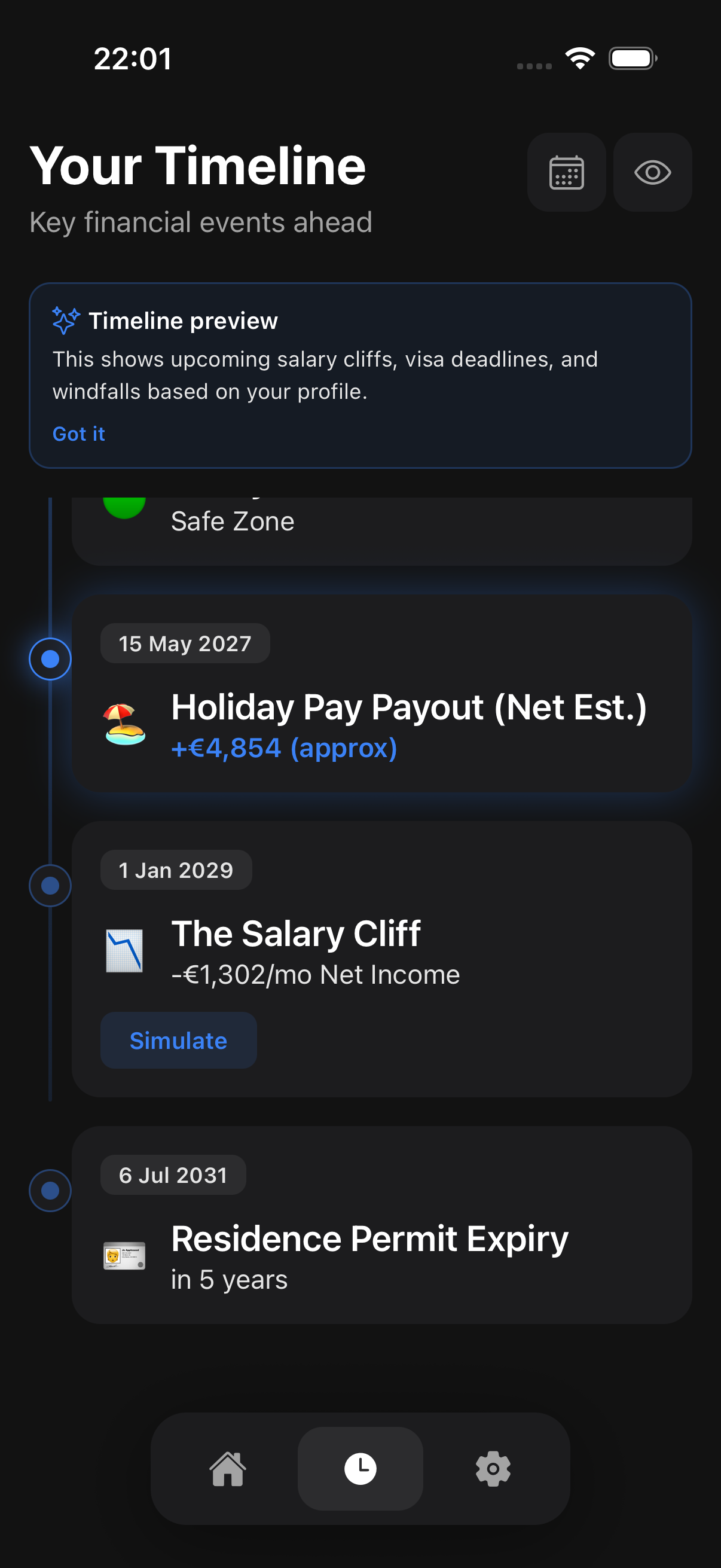
What changes next?
Keep the dates you enter on one timeline, including holiday pay, your 30% ruling, and residence permit.
03 / Your next move
Comparing a new offer?
Compare salary and benefits, then see estimated take-home pay with and without the ruling.


Your numbers stay yours.
Core figures stay on your phone. You decide when to hide or share them.
Privacy detailsNo account required
Incognito money hiding
Optional biometric lock
Try it with your own numbers.
Start with take-home pay, then add the dates that matter to you.


Questions Expats Actually Ask
Straight answers about the rules Dutch Defend helps you track, with pointers to verify the details that change every year.
How does the 30% ruling work for expats in the Netherlands?
The 30% ruling lets an eligible employer pay part of your salary tax-free to offset the cost of relocating for work, for a maximum ruling duration of up to 5 years. Eligibility depends on meeting a minimum taxable salary threshold that the Belastingdienst republishes every year, plus other conditions. Dutch Defend's 30% Ruling Cliff feature tracks your personal timeline so you can see where you stand. Always confirm your own eligibility and the current-year threshold with the Belastingdienst or a qualified tax advisor.
Related feature: 30% Ruling Cliff
When does the 30% ruling expire, and what happens after?
The ruling runs for a maximum of 5 years from when it starts. Rules that changed in 2024 also affect how the tax-free percentage steps down over time for rulings that began on or after that date, so two people with the same start year can be on different tracks. After the ruling ends, your net salary typically drops since the tax-free portion goes away. The 30% Ruling Cliff dashboard shows your estimated end date and helps you model the net-pay change before it happens. Treat it as planning guidance, not a legal determination of your exact end date.
Related feature: 30% Ruling Cliff
What salary do I need to qualify for the 30% ruling on a new job offer?
There's a minimum annual taxable salary threshold (with a lower bar for people under 30 with a qualifying Master's degree) that the Belastingdienst republishes every year. A specific euro figure quoted today can already be out of date next tax year. Instead of guessing a number here, Dutch Defend's Offer Check feature compares a job offer's salary against the current-year threshold and shows estimated net pay with and without the ruling, so you can see where an offer lands before you decide. Always confirm the exact figure with your employer's HR or payroll team.
Related feature: Offer Check
Does switching jobs affect my 30% ruling?
Changing employers can affect your 30% ruling. Continuity generally depends on how much time passes between jobs and whether your new salary still meets the applicable threshold, and the exact grace period is case-specific. The Job Switch Simulator lets you compare a new offer against your current one so you can see the net-pay and timeline impact before you sign, while Offer Check flags whether the new salary looks like it clears the current threshold. Always verify continuity rules for your specific situation with a tax advisor before switching.
Related feature: Job Switch Simulator
What is Box 3 wealth tax and when does it start applying to me?
Box 3 is the Dutch tax on savings, investments, and other assets above a tax-free allowance (heffingsvrij vermogen) that the Belastingdienst adjusts every year, and that can effectively double for eligible fiscal partners. Below that allowance, Box 3 tax generally doesn't apply to you; above it, tax is assessed on a deemed rather than literal return. Dutch Defend's Box 3 Wealth Tax feature shows where your savings sit against the current reference allowance as a planning aid. It's a bounded personal-savings comparison, not a full Box 3 assessment, since it doesn't account for property, debts, or partner assets, so confirm your actual filing position with a tax advisor.
Related feature: Box 3 Wealth Tax
What is the highly skilled migrant (HSM) job search period if I lose my job?
If your employment ends while you hold a highly skilled migrant permit, IND gives you a limited window to register with a new sponsoring employer before your permit is at risk of being revoked. The exact length can depend on when the job loss happens and other factors, and it never extends beyond your permit's own expiry date. Visa Radar keeps your permit and key deadlines visible so nothing catches you off guard, but the search-period rules involve genuinely open questions. Always verify your specific timeline directly with IND.
Related feature: Visa Radar
How much holiday allowance (vakantiegeld) will I get in the Netherlands?
Dutch law sets a statutory minimum holiday allowance of 8% of gross salary, typically paid out by early summer, though the exact wage base and payout date can vary by employer or CAO, and very high earners can sometimes agree to a lower rate in writing. The Vakantiegeld Tracker estimates your expected payout based on your salary so your spring cashflow is more predictable. Check your own contract or CAO for the exact rate and date that applies to you.
Related feature: Vakantiegeld Tracker
Am I entitled to a 13th month bonus in the Netherlands?
There is no statutory right to a 13th-month bonus under Dutch law. It only exists if your employment contract or CAO specifically provides for one, and neither the percentage nor the payout month is guaranteed to match any particular convention. The 13th Month Tracker lets you model your expected payout if your contract includes one, purely as a planning estimate. Check your own contract or CAO first to confirm whether you're eligible at all.
Related feature: 13th Month Tracker
Dutch Defend is a financial simulation tool and does not constitute tax, legal, or immigration advice. Tax rules and thresholds change every year. Always verify current figures with the Belastingdienst, IND, or a qualified advisor.
Tell us what is unclear.
Report an issue or suggest what Dutch Defend should explain next.